...when our hearts are full we need much less

  • Why the Hope?

    The defining moment in my life that shifted the way I was thinking...and brought me to ubuntu.

  • Who am I?

    Great question. Tough to answer.

  • What I do

    In the sense of living and breathing and working and playing.

  • Showing posts with label el salvador. Show all posts
    Showing posts with label el salvador. Show all posts

    May 13, 2013

    Noé, a member of the Atehucía agriculture group,
    showing off the fully developed squash plants.
    This was the first dry season planting
    on the plot in the El Molino estuary.
    The days when I receive the Otra Fe monthly reports are the best days. As I'm going through my International Development class, I find myself being able to relate so much of my learning to what is happening within this project. Jim tells us they are closer to establishing the not-for-profit status. I am excited for life to slow down so I can get more involved again. Perhaps once my course is finished.

    We still need to have a better alternative than renting land down there. Does anyone have a few hundred thousand dollars they would like to part with, for a sustainable food security project? Wink, wink. Let me know.

    In the meantime, visit the Otra Fe Blog here to read about how they are finding land to rent and taking better care of chickens than ever before, resulting in improved production of eggs and meat. And make sure to click on the reports for the pictures!

    April 08, 2013


    I continue to be blown away by the efforts of Otra Fe in El Salvador. Our own agronomist, Otoniel, writes these amazing monthly reports that summarize the activities going on down there and sends pictures where possible. Here is March's report below. 


    Remember this is a small group of campecino's who decided to come together as a co-operative and create opportunities for themselves where none really existed. This is a story of perseverance. 


    Report of activities carried out in Atehuecia Community: 

    5th of March:
    On this date the Atehuecia farming group met to discuss preparing the fields for the new period of agricultural production that will begin in the month of April with the goal being that the fields would be ready whenever the first rains come, perhaps very early in May. The conversation included the theme of tilling and caring for the land and its significance for today and for the future. Pastor Felix Lino accompanied the meeting.

    12th of March:
    This meeting took place in Chancuyo with the purpose of organising ourselves so that other persons would not burn their fields, and also to explain to other farmers the damage that is done to the earth when the vegetation left in the soil after the harvest is burned.

    22nd of March:
    Brother Felix Lino gathered the farming group to continue the work of consciousness raising with the families concerning the use of organic fertilisers making use of local resources such as the organic residuals obtained from their own households. The experience of some members of the group was also shared. These had  produced their own fertilisers using the residue from the harvest of the beans, shucked corn cobs, chaff from rice, and manure.

    2nd of March:
    We organised a get together to make organic fertilisers, using cobs, manure, ashes from the wood-burning stoves, and the remains from the bean harvest. 10 farmers participated in the event. The experience was later reproduced for 5 more families.

    16th of March:
    On this date we had the great experience of visiting 4 families in the homes and on their fields in order to see and know how the family fertiliser production is making out.

    Report of activities carried out in Monte El Padre Community, and with the farmers in San Diego hacienda.

    Generally speaking, the activities in both places have been oriented toward attending to the needs of the farmers (men and women) in their household tasks of looking after their chicken and egg project, principally helping with the reproduction of chicks. We also have been involved in the activities surrounding the search for land to cultivate this year. Preparation of land is already underway. There follows the detail of the principal activities.

    14th of March:
    Monte El Padre community meeting where we reflected on the condition of the land on the new plots that each of the families have rented or leased for the harvest in 2013, and, in order to preserve the small amount of debris that has been left on the ground, we are mounting a local campaign to explain to the neighboring farmers the damage it does to the ground when it is burned on the field.

    20th of March:
    In the hacienda San Diego a visit was made to promote soil care when performing the initial tasks of land preparation, mainly recommending that they prevent their land from being damaged by fire caused by other neighboring farmers.

    Brother Juan Ramón constantly is talking to the farmers about "the soil that produces life." It is important to emphasise the constant participation of men and women in the meetings and activities that have been conducted.

    8th of March
    We performed follow-up visits to poultry houses in order to check the overall health of the chickens and check their nutritional status and egg production. We verified also that compliance with the meal plan has been recommended.

    As a product of the new meal plan in March there was a daily average of 6 eggs per hen and there was also chicken and mature hens for meat more often than last year.

    22nd of March:
    We performed the first vaccination campaign for adult birds (over 18 weeks) that were near the beginning of producing eggs, and for chickens and small cocks aged from 4 to 17 weeks. That day a total of 125 birds were vaccinated.

    23rd of March:
    The second day of poultry vaccination was conducted on this date and a total of 170 were vaccinated since a vaccination of fowl in the neighborhood was implemented as a precaution to prevent outbreaks of diseases caused by viruses. On both days we had the support of the local team led by Don Armando Sandoval.

    The photograph shows the visit to one of the families
    that have begun to experience the production of organic
    fertiliser. Although it will not be sufficient for their plot,
    it will begin to improve the fertility of this year. 
    Brother Noah (2nd from left) shows the state of
    decomposition of his compost to Agronomist Otoniel.
    Brother Toño (right) already produced compost last year,
    but this year he is producing double the fertiliser
    to apply to all of his land, on which
    he grows corn, beans, rice, cassava and some vegetables. 

    January 13, 2013

    December was an exciting month for the project...there was growth in the areas of non-traditional methods of farming, as well as legitimate benefits of organic fertilizers showing their colours.

    From the report of our Agronomist:

    On December 4th, as part of the Otra Fe team's interest in searching out non traditional activities or options in the area of production and sale of foods, we went to visit a tilapia breeding project on the outskirts of the village of San Pablo Tacachinco, about 35 kms south west of the city of Santa Ana. There we had the opportunity to learn in great detail all the different aspects of raising and comercializing tilapia. Our purpose is to broach this idea in communities that have a sufficient water resource the possibility of developing in the medium term a project that would give them the opportunity to better their quality of life. This was also a good opportunity for training for the team.

    On December 12-19 y 26 meetings were held in Monte El Padre and Hacienda El Milagro in Texistepeque, as well as in Hacienda San Diego (near Metapan) with the goal of explaining in detail the benefits obtained in the soil by using organic fertilizers consistently. In 2013 it is proposed to put this to the test in a more extensive program. (I love this update because it's the first for sure we've seen about using organic fertilizers.)

    Check out the photos & project report here (warning: it is a versión de español)

    December 18, 2012

    Here are some highlights from the October and November updates from the fields of El Salvador. Our Agronomist, Otoniel, is the one sending updates and we thank him sincerely. Muchas gracias mi amigo!

    (I'm still working on my Spanish as I found a class in Kelowna to take...and I hope to visit the fields again this summer - money and time provided.)

    October 4: The project “Otra Fe” in the community Monte El Padre is causing interest among other groups of farmers, which is why we met on October 4 (Juan Ramón and Otoniel) with twenty-five farmers who cultivate small plots on the farm "El Milagro"in the jurisdiction of Texistepeque to share the vision of short, medium and long term goals that the project has in the technical area and in the area of farm values for family and community.

    October 20: Accompanied by eight farmers from the community Monte El Padre we conducted a technical inspection of second planting crops. We walked seven and a half kilometres to visit twelve plots cultivated with millet, squash and pipián squash which, thanks to the dedication of the farmers are developing well, with the assurance of receiving the expected harvest at the end of 2012.

    October 30: (This is my FAVOURITE kind of update to get!!!)
    With the presence of Pastor Juan Ramon and attended by 25 people, men and women, meeting of subsistence farmers was held (in San Diego) to talk about "community organization" to fight for the improvement of community health, education and food production. At the end of the meeting, the group chose a local board to represent them in present and future actions taken by the community.

    On November 30 Ramon Ramirez met with the group of farmers to have a motivational talk in relation to building harmonious community relationships and the local work of mutual aid and solidarity as basic practice in community development.

    Also on November 30th, the group met to give thanks for the blessing obtained through the harvest. Pastor Felix Lino pondered with the male and female farmers about the product obtained from the earth and responsibility to work the land and care for it.

    Religious or not, it's important to give thanks to the Universe / God / Buddha / Nature / Krishna or whomever you care too for the food that the Earth provides for us. What a special responsibility we've been given.

    Gregorio Escalante shows off his bean plants.
    He has had a good harvest & there will be food for the family!
    A group of farmers visiting Don Beto's plot of mustard
    seedings - a new crop for him.
    The hard work of bean harvest.

    Read the October report in full >>


    Read the November report in full >>


    To visit the Otra Fe website and to see all the reports, click here >>

    October 25, 2012

    I recently received our September update on Otra Fe - the Food Security project that I was in El Salvador learning about this year.

    This project is funded by a Canadian company, but currently managed by three amazing men that I met this year down in El Salvador.

    Here's an example of some of their meeting topics in Ahuachapan. (There are two Co-operative projects currently - one in Ahuachapan and one in Texistepeque):

    September 4 
    “Sustainable Agriculture” was the theme of the conversation on this date, in which a great emphasis was placed on care for the Earth on which right now we live as part of 7 billion persons, and there are still many to be born. It falls to farmers to be responsible to secure their food supply.

    September 8 
    We did a circuit of the parcels and gardens to find out how the second planting (principally beans) was making out. There were no apparent difficulties up to that date. On the same day we dedicated part of the afternoon to evaluate the results of the first harvest which was for food corn and to obtain seed corn from native varieties. Everything had gone according to how these men and women had planned.

    September 11 
    At the clinic in Chancuyo Canton, Ahuachapan, Felix Lino met with 20 persons with the purpose of promoting the organizing of the families that participated in the project with an eye to commercialising beans and corn from the first harvest so that a better price for the products could be obtained.

    September 18 
    With 35 persons participating, a gathering was held in a church building on-site with the purpose of sharing the experience of each farmer in the management of the crops established for his or her parcel, principally in management of infestations and diseases, and in identifying distinct varieties of beans.

    To me this is fascinating - that a small group of dedicated peasant farmers in El Salvador are truly making a difference. My role right now is so very tiny - to merely take their Spanish and translated reports and to make them accessible to a larger viewing audience. But it is so fun to be involved, to read the reports and recognize all of the faces within them. I sincerely hope I'll get a chance to head back down South this spring / summer to visit them all again.

    To read the whole report, pictures included, click here >>

    To visit the Otra Fe website and to see all the reports, click here >>

    July 09, 2012

    On my last day in Ahuchapan, we were invited to speak at a campecino meeting in a squatters village. As we walked in, I recognized several of the farmers as those that we have seen over the past weeks - in the fields and in the community. The meeting was to discuss the opportunity for the clinic here to become a working project again - and about the Food Security project. On this last day, a very special moment occurred:

    Jim & Felix were speaking (as I am still a-stuttering away in Spanish) and one of the gentlemen in the crowd motioned for me to come and sit between him and my favourite special lady - Maria - on a bench in the front row. Things slowed down for me a bit as I walked over, sat down, hugged Maria and gave her kisses and thanked him for inviting me in. It was a moment of being invited to sit with them, rather than stand apart from them. As I sat there, listening with the rest of them, tears came to my eyes because I felt for once that the difference between us evaporated - and just for a moment - I was one of them.

    Our last morning in the fields.
    To supply each of the campecinos one manzana
    - just enough for their family & them -
    we would need to fundraise between $150,000 - $450,000. 
    The clinic building that is currently abandoned, but
    ready to be fixed up provided we could find doctors and
    medicine.
    Our community meeting. Faces of the heartbeat of ES.
    So how do you begin to digest these intensive weeks I've had here? I've received big real life lessons in sociology, philosophy, theology, geography, agronomy and international development. There is a long road ahead of me over the coming days and weeks and months as I get my situation at home worked out. However, a number of priceless knowledge has been given to me and my heart - just as I felt coming home six months ago from India.

    I love how every conversation I've been having lately - be it with the community here, with the Canadians that were here building stoves, with my sister or with my friends that I met on the other side of the world - comes back to how we can make a sustainable difference in our own lives and the lives of those around us. And that starts with basic needs. We need to shift the way we are eating as we are causing ourselves all kinds of diseases. We need to shift the way we take care of Mother Earth as environmentally, again, we are causing all kinds of diseases and unrest...when in fact we are given this fertile earth that can grow amazing foods - without chemicals of any kind (unless you buy Monsanto-plagued seeds) - to nourish ourselves and our family. If each family had a little plot of land, a garden and some training, we would all eat well and be fully taken care of.

    It's almost as if we need to revert back to simpler times, keeping our knowledge and advancements where they serve humanity only. It means nurturing Mother Earth to provide for us only what we need and then giving back to her where we can. It means if I have a dollar in my pocket - and you have none - I give you a quarter to get started. To share and live equally and in harmony. This is true abundance.

    Abundance is not in having "things". It comes in having conversations and living in community. Abundance is having enough food to nourish our bellies and conversation, community and love to nourish our souls.

    In going to Central America, in simply taking notes and giving a few smiles and organizing the project a wee little bit, I have given a tiny bit of myself. Yet, I have been given so much. I've been given the gift of reflection and appreciation for my own life, family and friends. I've been given lessons in what it means to truly live and thrive off of a tiny amount. I've been given the gift of renewal in my faith for a better world...if only we can all work together to make that happen.

    Do I have to go back to my job? Yes. Do I like what I do everyday? Sure, most days. But in the end, does it give me the means to connect with others, to thrive in a communal workplace where we try to rise up for the greater good - that is left up to me to ensure. It could, if I work with the right type of clients who are wanting to do the right type of good out there. But does my job give me the means to try to continue on now, one step at a time, with my life? Yes. And as I figure out over the coming months where I'm going to move and what I'm going to do, I'm grateful for this.

    And where will I go with this gigantic development project that still goes on down in El Salvador? Well, I need to find what skills I can give best to it. That makes me think it's important to look at when I was happiest there. And that's easy, in two situations do I feel really excited and happy: 1) in organizing the projects and getting a handle on what is being done, what has been done, and what needs to be done. In making sense of the chaos. This is the business side of me coming out. 2) in walking with the people. I simply feel my best when setting one foot beside the other with the campecinos and their families.

    So what does that mean for next year? I have the opportunity to go down for a much longer time...to live and thrive within the community and to handle some of the project management. I'm not sure how I would make it work as this would not be a paid job, but from what I've seen, anything is possible. I just need Warren Buffett to read this blog and consider me as an investment...

    In the Mayan calendar, the 13th baktun is ending. A cycle of 5,125 days. In December, we'll be starting the next cycle on this planet and from what I've heard, it's going to be one much more focused on how we can undo the hurts that we've laid on Mother Earth and start to thrive together.

    The times...they are a changin'. 

    July 05, 2012

    In El Salvador there are about 6 million people. Roughly half of them live in or around the capital, San Salvador. The other half are spread throughout the small country. Here there are two insecurities that are creating major problems in the country:

    1) Physical Insecurity – i.e not enough people feeling safe
    2) and Food Insecurity – the food supply is just not stable

    Remember Maslow's hierarchy? These are two basic needs that are not being met. When was the last time you can remember when you didn't know for sure that you would have food the next day?

    In total, there are 350,000 peasant farmers (campecinos). These peasant farmers DO NOT own their own land. Before the recent land reform policy, 2% of the population of ES owned over 90% of the land. This figure has improved in recent years, but not by much. Los campecinos must therefore rent the land. However, many do not have the money to borrow to rent the land up front, so they take the land on a IOU, grow their crops and must give either the profits from the food or the food itself to the landowners, making them no better off than before. There is a law, similar to the squatting laws of North America, where if a peasant is on the land for so long, they own it. Therefore, each year the land is changed – meaning no campecino rents the same piece of land year after year. This means they are unable to adopt sustainable farming practices that will improve the land and crops year over year...yielding harsher conditions and less production over time. Not only this, but the good land is reserved for landowners...the land given to campecinos is therefore on a mountainside or another bad area – making soil erosion and gravity even more problems. And even worse? The only seed they can usually access is from transnationals like Monsanto. Monsanto uses seeds that you cannot reuse year after year because they are hybrid seeds – thereby genetically produced. We have an agronomist who thinks they come with the plague that affects most crops, meaning you must use their fertilizers - chemical fertilizers - which do nothing to help the earth or soil. So each year, 80% of people here do not grow enough to meet their own dietary needs, never mind the countries. They often have to take on additional work, like working in the sweat shops or cane fields – and often that doesn't even look after their family so they are left with unfriendly options. To starve or to leave.

    Salvadorans work with “manzanas” rather than acres. One manzana is equal to 7000 square meters (an acre is 5/8th of a manzana).

    Right now, what the country is lacking is sustainable and nutritious organic agriculture...for the people and the land. This was a theme that came up in every conversation we had with multiple authorities in the country – University Directors, Politicians, Theologians and Agronomists. Even those fighting for gender equality or those hoping to educate the youth agree that the number one need of the country right now is sustainable food systems. Otherwise, it could be disastrous in years to come.

    One politician told us of a practice that was occuring – and still is – in many places. For example, say the country needs 33,000 manzanas produced each year of food to feed it's people. The Government and other landowners were getting together and ensuring that only half of that – or less – was produced. They were then importing grains from the States for cheaper than what it costs to produce here – and selling it for more in the markets. There was big profit in this. But does it do anything to help the state of the economy here? No. It hurts the people who grow food in a BIG way and solely benefits the few at the top. All for a buck in their pocket.

    The other issue is that Salvadorans are one of the only economies in the world that run off another countries currency – the U.S. Dollar. Can you imagine if in Canada we had Abraham Lincoln and other U.S. Dignitaries in our face all the time? If we were to rise and fall with the States? How that would make us feel? I can't imagine. I am proud to be Canadian and many here are missing out on the chance to be proud to be Salvadoran. But the only way to get back to the colón? Raise production. The only way to raise production? Implement efficient and sustainable agricultural practices.

    The current government has a plan of action for making some progress here. But we have talked in-depth with an agronomist who is part of our project, Otoniel, and he knows that more must be done - soon. When we asked what the solution is, apart from hoping for a miracle or that the rich SOB landowners finally decide to share the wealth, he responded with this:

    "We need a chance to purchase manzanas of land to own. With this land, we could create a test plot that implements a couple of very important elements: 1) We will have land that can be used for a period of three or more years in a row, showcasing the absolute benefit of farmers having land on which they can implement sustainable practices 2) We will work with the community to understand their needs and plant what is required to meet them. 3) We will use only organic practices in order to help the soil and the earth. 4) We will use permaculture techniques and sustainable practices that will enrich the soil and create more efficient food production year upon year. 5) We will rotate depending on the years with chickens, beans, corn etc. This creates a cycle that increases the soil productivity and creates more food.

    We need to show the government and landowners the extreme benefits of food production in this way so that we have enough food to feed the country, but we can begin to focus development dollars on other needs for the country – like education, health and equality for all.

    With our own land, we can have an example that could spread throughout the country for the benefit of their most basic need. We can give life to the people."

    As the age-old saying goes, “Give a man a fish and he eats for a day, but teach a man a fish and he'll eat for life.”

    One of the peasant farmers with Project Manager Felix
    and Jim in the fields.
    Proudly showing off his banana plant.
    On our way to the fields, we found
    ourselves in a tropical jungle paradise with
    this little waterfall. Gorgeous.

    Finding water you could drink!
    Well, not for gringos...
    Now I must tell you quickly about my favourite lady, Maria. She is 72 years old and has a face that tells a beautiful story. Unfortunately, Maria has a son whom was "wrongly" accused of a robbery. His boss swears he was at work, but the courts are far from just here. Either way, she has to visit him twice a month in Santa Ana (which is about an hour away). She saves all her money to bring him supplies he may need and for the transport there and back - and thereby does not have the time to dedicate to her corn crop or to bettering her house.

    She stands about 4'5" and when she hugs me it's almost at my waist. But on the way to show us her house (at least a 2 km walk from the road), you better believe she was about twenty yards ahead of us at all times. She also produced a 2 liter jug of orange juice and cups (out of where? She's so small and I had no idea she was carrying it) in the middle of our walk to quench everyone's thirst. Grandma's just come prepared, right? They are magical (love you Grandma) and so is she. If I could adopt anyone to bring back with me, it would be this beauty.


    The leader of the Campecinos Organization
    Jorge - in front of Maria's house
    made...of sticks and plastic.
    After meeting with the campecinos repeatedly in the past week, I have no doubt that these guys are capable. They are hard workers and honest people. But they need help. They have lived through wars and mighty oppression. They have seen many die for no reason and have had days of wondering whether food or justice would come. After all the luck we've had in our lives, we will try to find some way to create just a bit of luck for them. The first problem is getting the land. After that will come seed, fertilizers, training, housing, education and health. 

    We have land secured that we could purchase. If you know of anyone who is willing / wishing to donate to this ongoing project, please contact me. It will go through the organization OTRA FE (A Different Faith). There are also many smaller projects that I will outline in detail later, including sponsorships of students, education projects, youth and senior projects and a clinic project. Any bit will help, but we do need a fair chunk. Let me know.

    Big love!

    July 03, 2012

    This last week we have got to spend some quality time in the fields with the campecinos (peasant farmers), and at their homes or in their churches with them. We had lunch at one of the houses where a lorena stove was being put in by the other Canadian group and sauntered through the fields with the families. The next day we went up to a different part of the project in the back of a truck, walking through maiz fields higher than our heads and 'taste-testing' the 'gardens of Eden' as we called it. They were growing everything from garlic to pineapple to cucumbers. Sunday they had a “welcome” service for the Canadians that had 200 people from the community out. And today, we walked into a packed hall of clapping campecinos, single moms and the “3rd age” (which is the old age generation here, the seniors, who have absolutely no pensions or security). 

    These people are the heartbeat of this country. They walk and work the fields by hand...hoping that this year they'll have the chance to grow enough to feed their family properly and to sell a little for school supplies and other basic necessities. They have weather beaten faces and often little education and yet (some of them) seem to know what really matters in life. A little food, a lot of laughs and family and friends. They are incredible beings.

    frutas stands, what a wonderful
    way to start a road trip
    The best naranja I've ever had. 
    coffee beans!
    a young boy in the midst of the coffee farms on the
    side of the mountain
    coffee coffee coffee farms
    Sonsonate nearby town mural
    I'll never forget how fresh this morning drives are..
    the women cooking on their new stove
    And to the fields we go..
    Three of the eight kids of one of the families....
    amidst all the green.
    Verde es el color de la vida y la esparanza
    "Green is the colour of life and hope"
    We took a walk through the river community.
    Three hundred forgotten families live here where our
    friend Ramon does some sponsor and education programs.
    I may get a chance yet to work here.
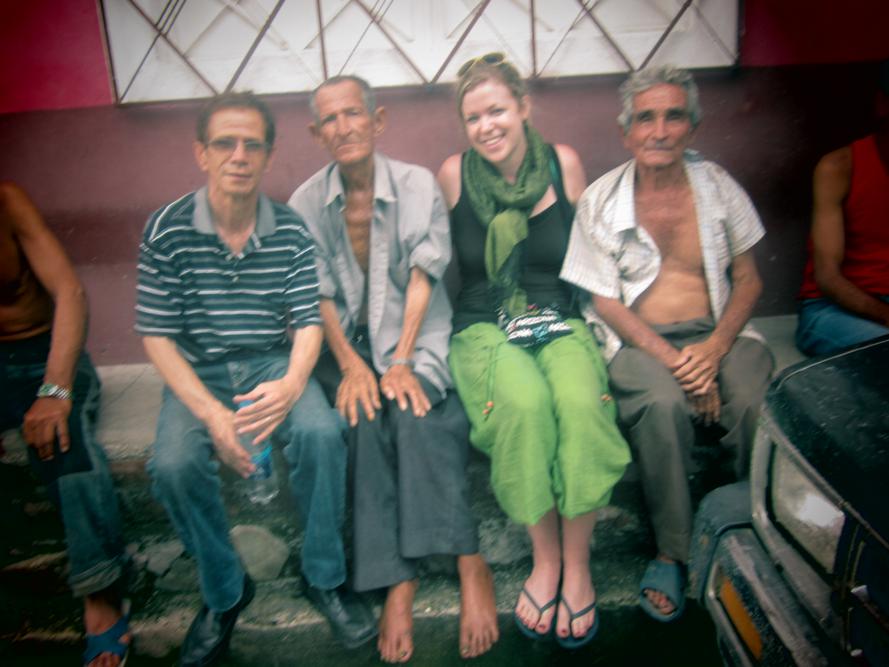
    The man to my left captured my heart. He has a
    parasite that makes him likely to die and no medicine
    can help. Yet, bone thin and weak from no food, he
    was charismatic and full of life. 
    Felix's people's part of the project
    I loved the sunshine that came into this pic,
    just as I took it. It epitomizes the beauty
    of the campecinos.
    The farmers explaining progress to us.
    Frutas...
    Claudia & kids in their plot.
    The one in yellow is Christian and is about as 
    Monkey paradise.
    Banana treees
    Rice
    Beans!
    Peppers
    Chillies
    Garlic
    More magical frutas
    Cashew nuts & fruit...together!
    Walking together with them, they have a pulse that I can feel in my veins. And each time we've seen them, they offer blessings and hugs and kisses for us all. I feel so blessed to be in their presence.

    This trip has me thinking about all of the important things in life...for there is a lot of tragedy and death here. And I received an email today from "The Daily Love" that helped me put this into perspective:

    No longer do I have the belief from my youth that I will live forever and cannot be destroyed. I am aware of the fragility, the temporary nature of my life.

    I feel a sense of urgency. There are no promised moments. This is NOT a dress rehearsal. I feel inspired, motivated and pushed to say, "I love you" to those I love as much as I can. I feel inspired to take risks. I feel pushed to look at my fear and step INTO it, rather then shy away from it. I am feeling time passing more and more and with it, it is whispering to me, "Do what you are afraid of, you won't regret it. Love out loud, you won't forget it. Live in the now, it is your present. The future is bright if you let it... be." 


    In this newfound sensitivity I am in awe of Life. It feels like in every moment I am waking up to something brand new, something marvellous and something mysterious. What really matters comes to the forefront...and everything else drops away.

    I hope today we are all living out loud for ourselves and those we love. LOVE!

    June 28, 2012

    Meetings, meetings and more meetings over the past few days...to help me understand the history and current economic, political and social situation for the country.

    Breakfast 27 de junio
    Dagoberto Gutierrez came to breakfast. This man is incredible. He was a Rebel Commander for the Guerrilla's in the war. He is a noted lawyer, theologian and public figure. He's in the news here often, cracking down on the right-side party. And he spoke to us about the violence and unrest going on in the world - politically, economically and socially. He spoke a lot about how our democracies have turned into dictatorships disguised. We vote, yet the money and power at the top still push down all regulations, laws and policies, often only those that benefit them. And it's gone on for too long, it no longer works anymore. Being in Dago's presence was special. He was so poignant and you could feel an energy around him that was big...I know I'll be following the politics down here a lot more closely after this.

    Dago & the other Canadians who joined us for the night.
    10:00 27 de junio at Universidad Luterana Salvadore
    Met with the President of the University, Fidel. Dagoberto is actually the VP of this University so he had heard a bit about us through him. This meeting was something else. We walk into his office and sit on these black leather couches. It wasn't a big luxurious room though, very modest. There's a large portrait of Che Guevara on the wall. Fidel didn't take off his aviator glasses once while he spoke to us about the state of E.S. I don't want to mention too much of what these guys said, but underlying themes included "The people need to rise up and it's time for revolution" and "We need to take the power and land and put that in the hands of the peasant farmers, rather than the transnationals or the rich...we need to invest in organic agriculture first and in the development of youth." I'll remember this meeting forever. All we needed was some Scotch and cigars and it would've been straight out of a movie. Unfortunately I wanted to be as sauve as him and therefore I did not ask to take his picture. But I really wish I would have. Forever in my mind!

    9:00 28 de junio
    Schafik Handel's son came to speak with Jim & I this morning about various topics. Schafik was the leader of the FLMN (leftist) party here for a long time, but died of a heart attack in 2006, before he was able to be president. He was very well respected and liked here and very well-known, so we were a bit surprised when he showed up to talk to us Canadians. He showed up wearing red, of course, the FMLN party colour. He explained to us some of the things that this leftist party is and has been trying to do since getting elected in 2009. They are the first leftist government to be elected, ever, in El Salvador and it's been a trying time. There has been so. much. corruption in their predecessor's parties and this is a transition time for them. They are making some progress; however, and one of those projects is called ALBA. It works around selling Venezuelan oil and every profit from that goes into rural development agriculture projects - with seed and fertilizer packages that are NOT from the transnational (criminals) like Monsanto and friends. Bueno.

    2:00 28 de junio
    Martinez (lawyer) from FESPED: a Human Rights organization
    This man was only a year older than me and already practising law for a wonderful foundation here in San Salvador. They really look at the government's policies and analyze them from a human rights prospective...holding them accountable and taking them to the courts if need be. And right now, they are doing just that. I won't go into the minutiae since I've done a lot of that lately. But this man was one of the great ones...the youth that is taking his opportunity to learn and be a defender of his country to the fullest. 

    He did say to us at one point, "I am surprised to see two Canadians who will give up an afternoon to learn the history of our country and culture." I was surprised to hear him say that. Give up an afternoon???? I find this fascinating.

    4:00 27 de junio IMU offices - a Women's Rights NGO
    Here we met with Dago's wife, Deysi Cheyne. She is the Director and a long time friend of Jim and Brenda's. I've heard so much about her that meeting her was a bit dream-like. She's beautiful and has a presence you can feel. She too was a guerrilla in the war, fighting for social justice in the rebel hills. During the war (1985) there was the third ever World Women's Conference held in Kenya and they came back from that knowing that gender quality was something that was needed in El Salvador. Ten years later, in Beijing, the idea was born for a government office to be held by women in ES. And IMU came out of that - as a Non Governmental Organization to hold the powers-that-be accountable and to pressure them when necessary. This organization has made a great deal of progress in the past 20 years and specifically in the past three years, in gender equality, lowering the femicide (murder specifically because of gender) rate, lowering domestic violence rates and pushing for things like maternal health and rural women education and economic empowerment. It's definitely an organization I plan to do work with one day.

    Deysi said something specifically to me that really stayed with me. She said something to the effect of, "We are fighting for something that we've never had, but you in Canada have it. Now it's a time for you to continue progressing and never let it go backwards. That must be your struggle. The struggle to keep and honour your rights." 

    Amen. To all the women in Canada. 

    On a lighter note, we stopped at a gas station to feel our tires this morning and had to cut the hubcap off as it was tied on with little tags. We asked the man beside us if he had a pocket knife or scissors in his car...and he pulled out a machete. 

    no. big. deal.
    Remember to not perch on the toilet people.
    Papusas! The national food.
    Central America. Gotta love it.

    The underlying theme here for everyone that has talked to us, no matter their position in the country, is that the country is in dire need of sustainable food systems set in place. So I am grateful that that's what I'm here for. Actual details on the Food Security Project that I'm going to be working on to come...we head for the country to walk among the fields with the people this weekend and next week.

    June 27, 2012

    Where can I begin this post? First, "Lucha" = Struggle. I am slowly falling deeper into this country and all it's history that no one seem to ever hear.

    I'll start with the bad...and try to end with the good. There's so much more than what I have time to pound out on this keyboard. In due time I'll share!

    First. El Mozote and Perquin's War Museum. We arrived in "Rebel territory" around 3 p.m. Monday after a night of driving in the dark, a lunch with a well known Pastor here in San Salvador talking to us about the war and drug trafficking and the powers-that-be over chimichangas and tacos, a morning of our car stalling and dying, ending in me directing traffic and helping to push the car down the street.

    So, when the war started, civilians headed for the mountains simply because that's where their opportunity rested. Where they could become strong, initiate peace talks, and collaborate hope for social justice. Where they could teach their community reading and writing and how to stand up for what you believe in - rights, justice, and truth. Yet also where they armed and protected themselves and showed they would not be taken without a fight. Although I am not a believer in violence, I am a believer in standing up and fighting for what you believe at your core is right. And for that I respect them.

    So the war museum in Perquin showed them. Their photos, their colours, their faces. The ones who were murdered and the massacred and were "disappeared" by the Salvadoran Government and Military. Our guide there was of a local indigenous tribe and explained that because none of them had the opportunity to become educated, the potential lies within the youth's hands to learn, educate and fight for the transformation of this country's social justice.

    El Mozote was different. It is a massacre site where the troops killed over 700 people in an intent to instil terror and fear in the people. In December of 1989, they gathered the people of this unassuming town in the town square and separated the boys from the girls. They killed the boys and fathers. They separated out the girls under 9 years old, raped them and killed them so their mothers would hear the screams. And then they came for the mothers. In this small town, there is a memorial wall that shows the names of all (they could find) who had died. There is a memorial church where the bodies of all the children are buried. The youngest in the community was 3 days old and the oldest, 90 years old.

    Learning about what it was really like during the war
    and the now (and ever) present economic &
    political issues from Carlos & his wife.
    No more repression.
    Our trip to El Mozote not starting off well..
    They are not with the dead,
    they are with us
    with you
    and with all of humanity.
    The genocide memorial.
    The memorial where all of the children's bodies are buried.
    In the garden of reflection near the site.
    There is still beauty present amidst all the sorrow.
    President of the Human Rights Commission
    of El Salvador. Assassinated for defending
    the rights of her people, March 14, 1983
    The faces of the war.
    50% of Salvadorans live in misery.
    At the bottom it reads: Join the
    National Campaign to stop the
    U.S. sponsored bombing
    of El Salvador.
    See me?
    "Salvador" (his rebel name) after speaking to us about
    the cooperatives and his part in the war.
    At our small hotel, we had a humble dinner of rice and plaintains and a man came to sit with us. He told us of how he was in the rebel troops. The army was taking people from every village or killing them so him and his brother fled. He was 11 at the time. He had been shot three times and showed us his scars. Yet his outlook on the war was a positive one, which was ...different...nice different...to hear. He learned to read, write, cook, work with propaganda and the press and do special projects. He felt that the war showed the people that they had a voice and allowed them the opportunity to realize their potential.

    Yesterday, we went first to Oscar Romero's Chapel and then to the University of Central America. Romero was a pastor of the people. He was elected Archbishop and had decided to keep politics completely out of religion. He didn't want a part of what was going on in the country outside of religion. However, his best friend was assassinated a year later and that began to change the way he saw what was going on in his country. In his last sermon, he called on the army to put down their arms and to stop killing their own people. The next day, March 24, 1989, he was assassinated when giving mass. Shot through the heart by a drive-by sharpshooter (who is now a car dealer in San Francisco and lives safely in the States). He had been quoted months earlier saying that if he was killed, his spirit would rise in his people.


    Next, at the UCA, six Jesuits were hauled out of their rooms and murdered by the Salvadoran military..along with the housekeeper and her daughter whom were raped & murdered. Brutally. I saw pictures of their dead, ravaged bodies. I felt sick to my stomach with the evilness of humans...which created a philosophical discussion last night at dinner about what this evil balance is in life? Where did it come from? Is it man? Is it the "devil"? Is it money and greed? Or all of the above? Honestly, it raises so many questions that we can't begin to answer at this time.

    Yet, there is the good. The University is now about hope. It is taking all middle class students and part of their program - every program - is working with the poor and among the poor. It's turned something awful into something resilient and strong. It's turned into an opportunity for the youth and humanity of El Salvador.

    Just prior to posting this, I've posted a blog titled "Let the Poor Break Your Heart". It is written by Dean Brackley and is from a short book titled The University and Its Martyrs: Hope from Central America. I found it profound and I hope you take the time to read it.

    The point from where Romero was shot, just outside the
    doors in a drive-by shooting.
    "If I die, I will return & rise in the Salvadoran people."
    Spoken a few months prior to his assassination.
    Last night Otoniel talked to us about the hope for a Food Security Project (the one I am here to potentially intern with next year). More to come on that. Today we're meeting with a former Rebel Commander of the guerrilla army and his wife, the Director of the Women's Rights Organization whom Jim and Brenda know well. And Thursday...if you can believe this...she has us lined up for a meeting with the (correction) Director of a Salvadoran Human Rights Organization for FESPED (Fundacion de Estudios para la Aplicacion del Derecho)!! Excuse the punctuation marks, but I am mucho, muchisimo excited.

    The rebel army hills.
    So much beauty, hope & resiliance in this broken land
    of El Salvador.