...when our hearts are full we need much less

  • Why the Hope?

    The defining moment in my life that shifted the way I was thinking...and brought me to ubuntu.

  • Who am I?

    Great question. Tough to answer.

  • What I do

    In the sense of living and breathing and working and playing.

  • Showing posts with label women. Show all posts
    Showing posts with label women. Show all posts

    March 07, 2015

    “Words are things, I am convinced. You must be careful, careful about the words you use. Or the
    words you allow to be used in your house.

    You must be careful
    Careful about calling people out of their names

    Using racial pejoratives and sexual pejoratives
    And all that ignorance
    Don’t do that

    Someday we’ll be able to measure the power of words

    I think they are things
    I think they get on the walls, they get in your wallpaper, they get in your rugs
    In your upholstery, in your clothes and finally…
    Into you.”        - Maya Angelou

    The other night I attended an International Women's Day event at the Okanagan Heritage Museum. There was a panel of five, who discussed a number of varying topics from indigenous rights to gender equality to marketing to men to colonization and the list goes on. They were an array of activists and rather smart cookies, and towards the end the panelist host asked, "Sometimes it's just all too much. The problems are too big. How can we even help?"

    Welcome to my heart. This is how I feel every day. Sometimes I want to conquer the shit out of the world and other days I start to hyperventilate thinking of everything that is broken out there. It seems daunting and oh so overwhelming.

    So, I was very interested to hear the replies. And they were oh so surprisingly helpful:

    • Teach your children about human rights.
      Pass values down from generation to generation. They are the future. Teach them to stand up for their rights and others. Teach them to respect everyone regardless of age, gender, ethnicity. This is a no-brainer, but it's HUGE! It will be what changes the world. 
    • Rejoice in the little celebrations
      Sometimes the movies or pop culture can make it seem like movements can take place in a day, week, month or year. Perhaps a couple years. But in reality, most movements are going to take a lifetime or more. Everyone is waiting for the BIG celebration - the day gay marriage is legal everywhere, the day that indigenous rights are fully restored, the day that gender equality is legitimate around the world. But the truth is, those things might not happen in our lifetime. It did not take a year to abolish slavery or to get the women's right to vote. But every step forward is advancing to that point and each moment counts. Therefore, we have to rejoice in the little things - the days when you hear children in your community caring for someone who has been bullied. The day you hear headlines like "Fredericton High School students hold dress code protest" - amazing. The day you realize that Jian Ghomeshi made the front news for weeks because he treated women wrongly and that finally it deserves a spotlight in the media because it's NOT okay. Let's celebrate these small moments, for they make the movement. 
    • Organize an action of your own
      This is a great one and one I've never done solely on my own. I love taking a part in any kind of movement; however, and so last night I thought - well why couldn't myself and a couple of friends host that? We had an in depth conversation about this afterwards. Perhaps this is something that will come to fruition for me soon. 
    • Self educate
      Big one. So important. There are so many times that people want to do something and they just don't know what. So start somewhere - read about it, go to lectures on it, attend webinars or seminars, volunteer with an organization close to the cause, and the list goes on. You can get involved by merely picking up a book (to start). It's easier than you think! 
    • Speak up against injustice anytime you see it
      If you are in line at the grocery store and someone is being treated wrongly, say it. Say it out loud. So often we hear injustices and pass them with a blind glance. Everyone thinks, "someone else will say something." But what if it could be you? What if someone else was you? 
    • Listen to every single story
      One of my favourite parts of last night was a woman who said, "When we connect and listen to each other's stories, we are already fighting the large forces of oppression." Listening is a radical force in itself. Really listen to other people's stories. Take a moment to figuratively walk around in their shoes. That in itself is so loving and so nourishing.
    • Deconstruct harmful thoughts and beliefs in everyday life
      I think this is exactly what Maya Angelou is talking about up above. One of the panelists was a young man who works in marketing and studies marketing for men. He said often when a client is describing something to him they will simply say, "It looks too masculine." When he asks what masculine means to them, specifically, they start deconstructing it - it's too bold, too dark, too many harsh, straight lines, basically it's too foreboding. So he takes that opportunity to ask why that necessarily means masculine to them and starts a conversation that may shift their perspective. It really is a radical thought that you can start taking away negatives in any daily conversation. 
    Ultimately, it comes down to one thing.

    You must be careful about the words you allow in your house. And by changing your daily interactions, you can change the world. 

    March 06, 2015

    Well my lovely friend, it's been awhile.

    The third last time I wrote was (you guessed it) International Women's Day last year.

    That's okay, I have been busy. Moving out to the woods and switching jobs and MCing weddings and sitting in meditation retreats and hiking the forest of my backyard and learning about International Development and social change and travelling to Vegas, Chicago, San Francisco, Halifax, Arizona, going home and spending time with my nephews and niece and well, just living.

    But I'm back. For a very simple, yet significant, reason. It's time to celebrate women again.

    Tonight I spent a couple of hours learning from a variety of women (and men) with different backgrounds, ethnicities and academic views, about what International Women's Day means to them. I then sat at a cozy bar drinking red wine with two amazing women friends of my own, debating the life and times of being a woman and what International Women's Day should really be about (in our minds).

    There are sooooo many different trains of thoughts about what this day could mean (if, might I mention, you have ever even heard of this day. Sad to hear that so many people apparently have not. It's March 8th by the way, and has been around since 1908.) To some people, it could be a day to dissect and stand up for indigenous rights, LGBT rights, men's rights, civil rights, or gender equality. It could mean debating the difference between men and women and why don't men have a day? It could mean dissecting the various segments of being a woman - transgender, gay, bisexual or feminist.

    But, after much reflection, I strongly believe it all boils down to this:

    International Women's Day is a day of celebration for all of us.

    It's a day of solidarity.

    It's a day to rejoice on the advancements we have made over time, as a full-on-doesn't-matter-what-race-culture-age you are. It's a day to rejoice about the general species of: women.

    A quick google search will show you about twenty sites that have these sad stats about being a woman:
    • Women perform 66% of the world’s work and produce 50% of the food. However, they earn just 10% of incomes and own 1% of the property globally
    • Out of 197 countries, only 22 of them have women currently serving as heads of state — just 11.2%
    • In business, the gender gap remains wide. In the United States, for example, only 21 of the CEOs of Fortune 500 companies are women.
    • In nearly every country, women work longer hours than men and are paid less*

    But what I'm looking for are these kinds of facts:
    • There are currently 17 countries with women as heads of government, heads of state, or both; this, according to the UN, is more than double what it was in 2005 (yes, this site said 17 instead of 22. It was written earlier than the one above, so look, we have five more in that stat above! More progress!)
    • Generally considered to be the world’s first novel, The Tale of Genji was written in Japan around AD 1000 by Murasaki Shikibu—a woman.
    • The two highest IQs ever recorded on a standard test both belong to women.
    • Mary Queen of Scots has been attributed to creating the world’s first golf course.**
    (Yes, the above seem like random facts, but I googled over and over "positive facts about women's rights" and "positive International Women's Day facts" and yet these were, quite literally, the best I could find. Hmmm. Next blog - more celebratory women websites).

    In all seriousness, this week I have thought long and hard about what it means to be a woman. In my short life I have traveled to nations that are the poorest in the world. I've sat with women in oppressed regions: in the slums of India, in the dust and dirt of El Salvador. I have seen them laugh. I have seen them rise up against domestic violence. I have seen them plant food and cook feasts, nurture their children, and show more kindness than I knew possible. I have seen ingenuity. And brilliance. And passion. 

    I have also sat in elite boardrooms with some of the most intelligent women to walk the planet here in Canada. I have seen those who have the most incredible outward (and inward) beauty - the best clothes that money can buy, the best make-up, the best hair, the nicest houses, the whole damn white picket fence. 

    I have loved and admired both sets of women alike. And I've seen so many similarities. I have seen hard work and determination and grit in each and every single one of them. I have seen wisdom, grace, and nurturing spirits. It doesn't matter which set it's coming from, there is something seriously special about being a female. 

    So what does being a woman mean, universally? 

    It means loving with all of your heart. Taking risks and being vulnerable and opening yourself up to heartache on the behalf of others. It means spending long nights cooking and cleaning for people so that they will be pleased, happy, and nourished. It means not worrying about getting credit for the love that you bestow constantly - the light that you shine, because seeing others happiness is enough. It means loving from afar and letting go and holding tightly and not wanting to let go. Being a woman means being a life force. Literally. It means passing on the eternal breath of nature. It brings about motherhood, which I have not stepped into yet, but experienced through so many of my very closest loved ones and my own (possibly the best woman alive) my mother. This, to me, is everything in life. This has given every single one of you reading this LIFE. That is no small feat. That is no mistake by nature. That is something that needs celebrating.  

    Being a woman means creating connections with girlfriends that only sisterhood can understood. It means that when a friend comes over after a heartbreak, you get the chocolate cake ready. It means when a friend is really going through tough times, you get the spare room ready, no questions asked. It might mean planting a garden, doing eight loads of laundry, settling thirty disputes, changing five diapers, cooking dinner for the family, and planning the next grocery list - all in eight hours. It might mean traveling all day for work and listening to eight co-workers concerns and making them feel special and forgetting to do your own yoga practice because other people need you and calling your girlfriend at 11 p.m. when you're meant to go to bed because she needs to know what to wear tomorrow. 

    Being a woman means that you truly care.

    It means being a mother, a sister, an aunt, a grandma. 

    It's something that you cannot describe in so many words.

    It means so much. 

    My biggest wish is that everyone, on Sunday, March 8th, will spend the day just rejoicing in the womanhood around the world. Thank the woman next to you, or the one that gave life to you. Let's forget all the other segments it can break into and for one day - let's just celebrate womanhood.


    * Source: http://www.theglobalist.com/10-facts-international-womens-day/
    ** Source: http://www.levo.com/articles/news/facts-about-women-international-womens-day


    June 24, 2014


    [wild-craft-ing] v.
    the harvesting of herb, root, flower or inspiration from the wilds

    [stew·ard·ship] noun
    the activity or job of protecting and being responsible for something
    an ethic that embodies the responsible planning and management of resources

    I spent the last three days at the Wildcraft Forest just outside of Lumby. I connected with  Don (the lovely man who is a steward of the land there) last year through finding his website. We were meant to meet earlier and things didn't turn out. So I jumped at the chance to attend the second ever Wildcrafting Basics course, that leads one to the Wildcrafting Bioregional Studies Certificate (WBSC). Last week we were assigned homework to do a report on three plants - two that are native to the interior of BC and one that is "invasive"(what a terrible term). We were also tasked with looking back, like faaaar back into our ancestry, to 5000 years ago. To imagine the life we would have lead back then. Due to how busy I've been lately, I was a tad stressed. I guess I am a bit of a perfectionist in some ways and wanted to be fully prepared.

    Nothing could have prepared me for the weekend (and yet everything in my life up to this point has been preparing me).  More on that later.

    So from the beginning. My friend Lisa and I packed up her camper and took off, with no expectations of who or what this course would be like. We are both drawn to the woods, to sustainability, to philosophical conversations about what life really is about. It just felt right. We knew all of the above would happen. We arrived and immediately met two lovely women around our age, of the same like-minded ideas. It was an instant bond. As other class members arrived, it was apparent that we were indeed a clan of sorts. There was instantaneous connection and an awe and wonder for the Earth and all that her majesty has to offer us (and more, about what we can offer back).

    After delightful conversation (where I actually exclaimed, "I love you," to Pam - one of the attendees there. Too soon? Haha) we dove right into spiral harvesting (over foraging) of wild strawberries and wild mint. Don was harvesting the leaves these for his wild teas, so we got to eat a few of the delightful miniature berries. Delicious. Until the roosters on the property came along and helped themselves to the whole field. Fair enough, these roosters (called Lord Voldemort and Panama) well they need to eat too. We also met Wizard, the spiritual dog and faithful companion of Don's. He became a constant for the weekend, as wherever we went, Wizard would follow.

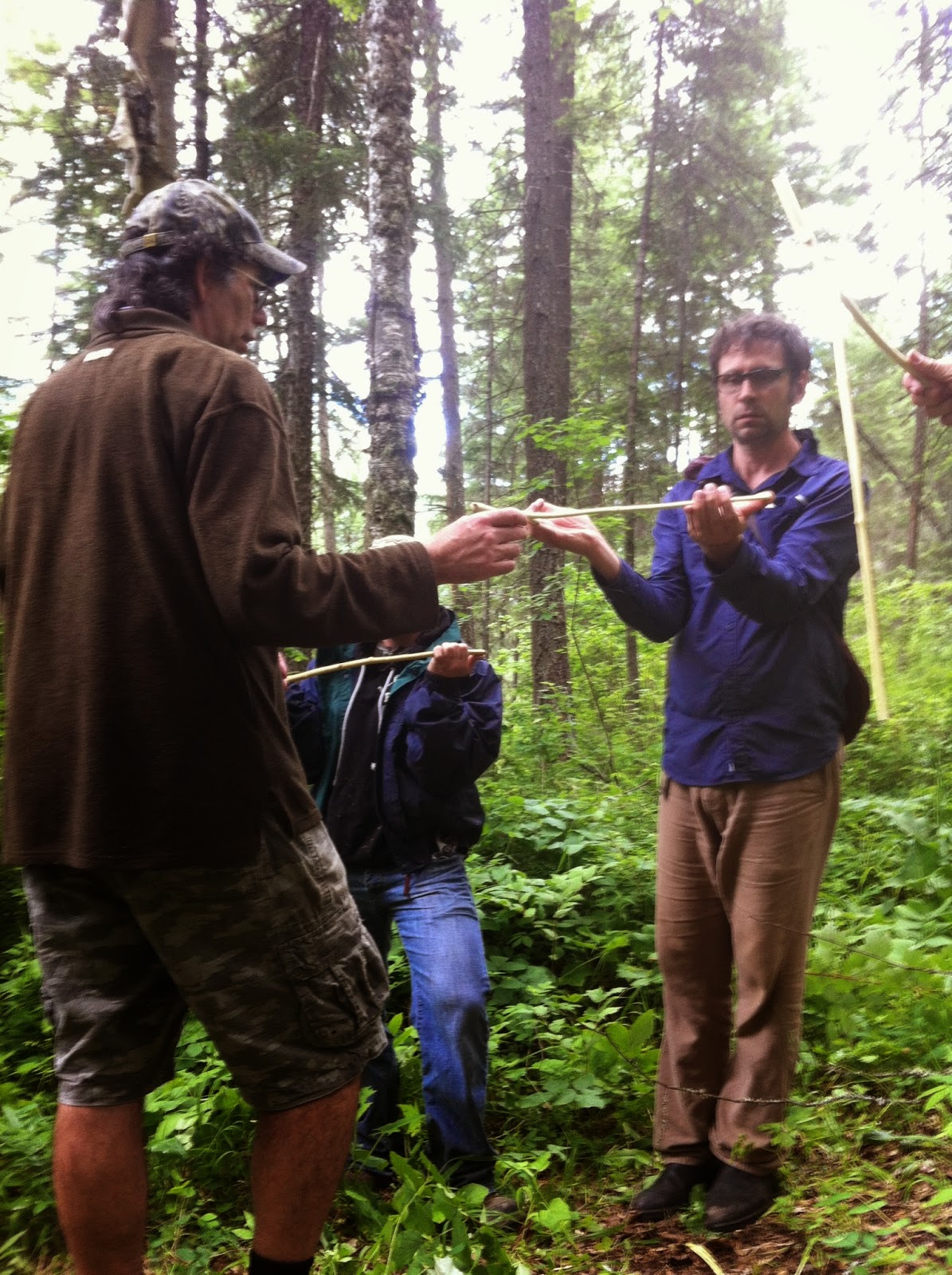
    We then learned about the ancient art of dowsing and were able to create our own dowsing sticks. Dowsing is a type of divination used to locate ground water, buried metals or ores, gemstones, oil, gravesites, and many other objects and materials, without the use of scientific apparatus. It is an ancient art and incredibly interesting. It lends itself to the idea of an ancient muscle memory. I won't spend too much time on this as it's something more to be experienced than explained. Following our first foray into the woods, we came back to camp and used Don's pendulum to ask a few questions. We got some interesting answers later that evening around the fire...
    Hwy 6 -  if you ever get a chance,
    drop in to this magical place
    Spiral harvesting. No clear cutting / foraging.
    Home for three days:
    Forest.
    Fire pit.
    Medicine wheel.
    Teepee being wrapped in wood.
    All the essentials.
    The wise eyes of Wizard.
    Learning the ancient art of dowsing.
    Later Friday night, we had a smudging ceremony, and had rich conversation about the reasons why we came around the medicine wheel and the Four Directions. This consisted sitting around a stone monument that's a symbol in North American indigenous culture. Where you sat mattered, as the Four Directions have symbolism in each. There is the deer to the west (gentle spirit), the coyote to the south (trickster), the bear to the west (leader) and the eagle/owl to the north (visionary). Without knowing, I sat between the bear and the eagle. During this ceremony, I had a major moment. I was sharing my story of what led me to that exact moment and as I gazed out over the Sleeping Coyote mountain in front of me, with the sun setting, and heart enriching conversation, something whispered to me that my leap of faith that had me pack up my belongings into a car and move to Kelowna without knowing a soul, was right. That my steps to move towards an agricultural based company was right. That my friendship with Lisa wasn't a coincidence. These were all steps on my journey to this place.

    I struggled finding the words to describe this moment of the weekend, so I found this description of a medicine wheel and thought it too perfect to not include:

    "a Medicine Wheel can best be described as a mirror within, which everything about the human condition is reflected back. It requires courage to look into the mirror and really see what is being reflected back about an individual's life. It helps us with our creative "Vision", to see exactly where we are in life and which areas we need to work on and develop in order to realize our full potential. It is a tool to be used for the upliftment and betterment of humankind, healing and connecting to the Infinite."

    After all of this activity, we still had two days left. So we built a beautiful fire and shared further stories about lucid dreaming, pioneering ideas, about what life really means, about the broken system we find ourselves in. I fell asleep so utterly content and slept for eight hours for the first time in a long time.

    Saturday started with enriching conversation based around terroir. Terroir can be loosely translated as "a sense of place," which is embodied in certain characteristic qualities, the sum of the effects that the local environment has had on the production of the product. This includes the soil, the geography, the climate, and best of all, the story of a product. Imagine the wine in France, where terroir comes from. It tells the story of the place where the grapes are grown and why that wine is so special. This lent itself to being a more business-minded conversation about becoming an artisan, or a product designer, and about how to contribute to the economy and tell the story of your products to the marketplace. This isn't all "hippie" stuff people! It's business that comes with a high level of spiritual ethics.

    From there it seemed natural that we would jump to the career side of wildcrafting. The categories are loosely divided into six paths:

    • Designers (product design, community planning)
    • Healers (making medicine, plant knowledge, ancient arts, healing memory)
    • Alchemists (transformation of dyes, fibers, medicines and plants into food)
    • Guides (communicators, counselors, dreamwork, pilgrimage)
    • Teachers (learning, sharing, mentoring, media, broadcasting, storytelling, communicating)
    • Navigators (leadership, biosemiotics, negotiating, advocacy)
    The vision that Don holds for wildcrafting is truly original and incredible. One of my favourite chats we had from the weekend was this:

    "Wildcrafting is what the environmental movement should have become. It's not about going to lawmakers and petitioning them to make change for us. It's about making change in ourselves and the environment we are living in. If we each take that responsibility unto ourselves, we can create a movement bigger than anything that a law or government in it's current state could do."

    It's about our obligation as dwellers on the earth, to take care of what we have for future generations. And, as you can see above, there is a way for this to be done, and to make a living from it. It's a new kind of economy, ruled by the nurturing Gaia. And he believes this will be a movement. That every health food store, or grocery store for that matter will need a wildcrafting practitioner. Every restaurant and hospital. It really will become the wave that drives the human race forward in a way that the earth can support.

    We spoke this weekend about true permaculture and bioregionalism. About creating a design system which aims to create sustainable human habitats by following nature's patterns. And about creating ecological, political and cultural systems around naturally defined areas. What an inspirational time to be living here in the interior of BC.

    The piece that came out of Saturday's morning conversations for me was the Aha moment of why I've spent the past ten years in marketing and communications. I'm here to tell a story. The world is a web of stories. The more we can find people to tell the right ones, the better off we will be.

    Then we were off on a field trip to the Shuswap River.
    The beautiful Shuswap River
    Identifying horsetail & wild gooseberries
    Known to keep away evil spirits...
    Ferns! With markings underneath! Is it Bracken or Lady Fern?  
    The oh so glorious and important forest underlayer
    Learning about culturally modified trees. 
    The Queen's Cup:
     - used as an eye medicine and to stop bleeding
     - berries used for a blue dye 
    The very versatile Thimbleberry
     - berries eaten fresh with other wild berries
    - young shoots can be peeled and eaten raw or cooked
    - large, maple like leaves to be used as temporary containers
    - the leaves can even be used as toilet tissue for hikers
    Can't go into a forest and not sit
    on a log & have a quick ponder can you? 
    And once the enlightening field trip (where we also discovered beauts like the cottonwood trees, oregon grape, birch trees, streambank buttercup and wild ginger) it was time to head back to camp and collect items for dinner.
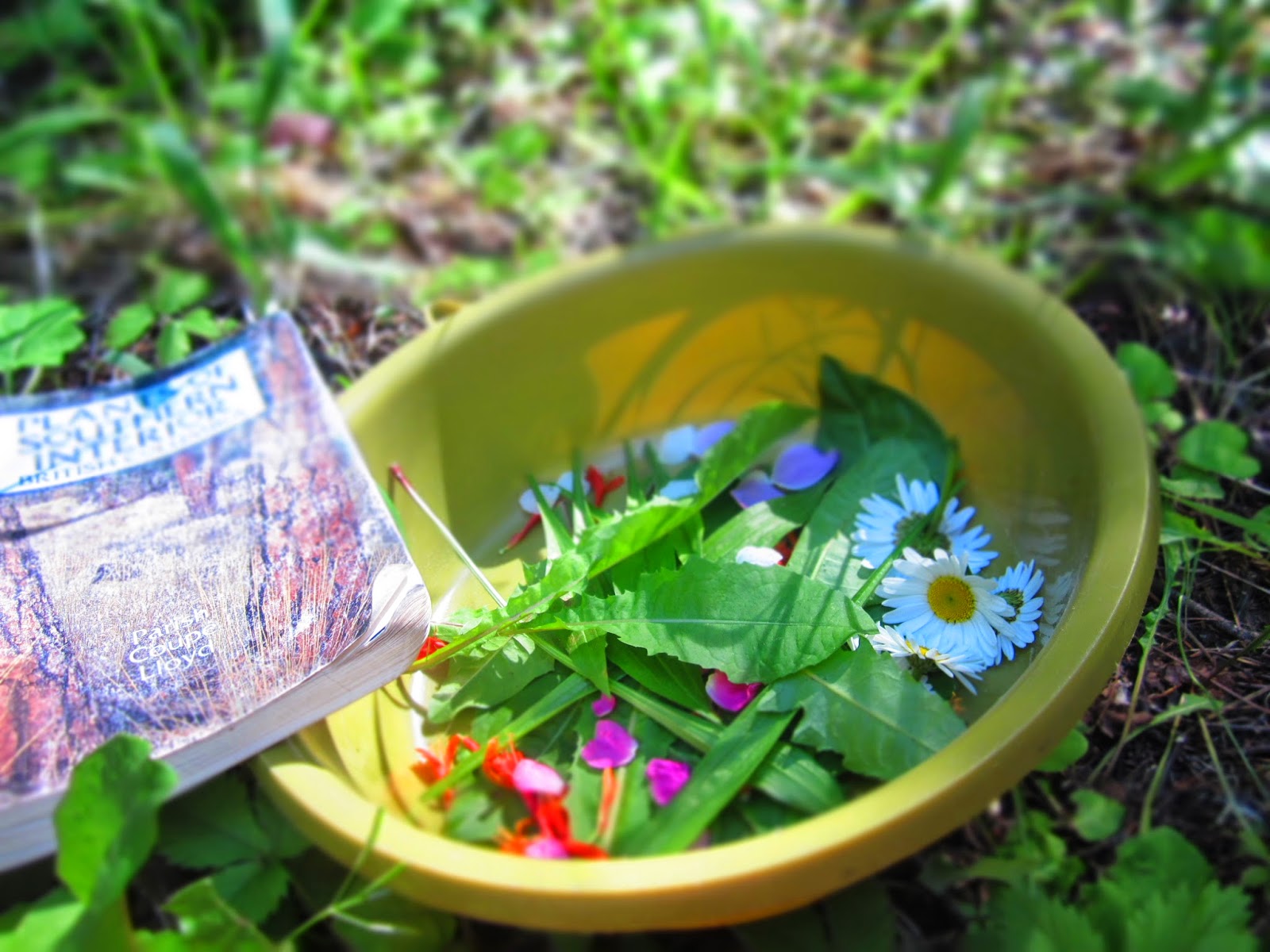
    Gathering an oh so beautiful salad 
    Puffball mushrooms! This was about the size of a soccer ball
    and felt like a kneaded piece of dough.
    Finding dinner in the sunshine.
    And coming across a meadow of oxeye daisies.
    Let's add those petals to our salad...
    Pam & Jaime creating a delicious paste for the salmon.
    Prepping for the burdock root pancakes
    The aromatic woods. Nowhere I'd rather be.
    Burdock root broth with chives & mint 
    Campfire cooking...
    and ever present stimulating conversation
    And our final product, with sun tea
    (and black currant wine for the girls) 
    With full bellies and happy bodies, we then did our plant presentations over a crackling fire. With nine of us, it was amazing that there was not one overlapping plant that we chose. It was truly incredible learning about the characteristics, spiritual and medicinal values of over twenty different wild plants. To name a few, we had wild mint, skunk cabbage (a light shining in the swampy dark), mugwort (a great plant for women to get to know), wild honeysuckle, heart-leafed arnica and tall bluebells (all related to my favourite thing - LOVE), pine pollen (a testosterone booster for men), giant hogweed (instilling fear in parents everywhere), the tiger lily (to add a little pepper), and Japanese nutweed (the plant that doesn't seem to have much wrong with it - other than minor architectural issues - this guy will grow through walls...but that is so healing that it's perhaps natures way of forcing us to listen). There was great mullein plant (an aphrodisiac), the red columbine (a good luck charm), and skull cap (beware of giddiness and happiness).  What. an. education.

    After a rich after-fire discussion of boycotts, the book of Enoch and our raison d'être, we retired to bed for another restful slumber.

    Upon rising, I realized it was the last day. This created a stir of emotions. I was overwhelmed with information and needed to digest it. I was faced with aha moments of my own skills and talents that I need to share with the world. I was terribly sad to leave the no-cell-service-oh-so-peaceful woods and the clan that we created. But I was ready to face our last day, to soak in what I could, and to come home with a sense of purpose.

    And then Robert MacDonald came to speak to us. Robert has a rich past, full of marketing (for great things like the Grateful Dead and household items like the decorated Kleenex box), publishing (worked for Random House - hello hero!) and consulting, all the while keeping his spiritual values and morals in tact. It quickly became clear to me that I am meant to study further under this man whose background has slight similarities to my own that I'm starting. However, the one story that Robert told struck me as something that needed to be told, and it is this:

    When he was working for a typography company, he learned the story of the building he worked in. It was built by construction workers that were far ahead of their time. It was a huge, intricate building, built in stone and other sturdy materials. However, there were certain parts that needed the flexibility of wood. So the builders knew that this would have to be replaced about 300 years from then and built the wood in such a way that it would be easy to extract and replace. Then they took things a step further. They planted an oak tree forest surrounding the building, that would grow for 300 years, mature, and then the wood that was needed was right on site.

    Do you see the sustainability in that?

    Do you realize that that's how we need to be thinking - 300 years out?

    We all want to leave a legacy. What can we do, that will be a story, that will inspire future generations, and that will leave them better off?

    That's what we need to be thinking about.

    I was captivated by his message and am starting to understand that I have to shift my thinking to this way. Not only this, but it's storytelling that will continue that message along. It's the story of Ogopogo (to potentially protect boaters from methane eruptions?) It's the story that we have heard from our parents about who we are and where we come from that shapes our lives.

    We have to think about our story. Every generation and culture needs a story. And we have a moral and ethical obligation to set it up right now for 300 years from now.

    Sunday afternoon we talked to a man named Matthew Stephens who studied permaculture from the grandfather of permaculture himself: Bill Mollison. Matt is now designing a food forest and community garden in inner city Chicago. He is a guerrilla gardener that is changing lives. These kinds of visionaries are who we need to step forward and blaze the path. We also got into a very animated conversation about the naysayers. Those who may need to see certification in this path in order for it to be credible. Or those that simply look at us and say that we're "hippies." But I ask you this:


    And what if my buisness background allows me to understand the economy - and not to simply "check out" of society like many hippies are accused of doing. I think there's a true path that we can follow that takes that which we need to do and makes it accessible to all, still allowing lives of comfort (maybe not luxury like there is now, but comfort nonetheless) and rich conversations and rich spirits and delicious foods? It creates a world of community and rights some of the wrongs that are so clearly, blatantly happening right now around the world.

    Deep deep down, somewhere, you must hear the whisper.

    And there's tangible things that you can do. Grow your own food or support those that grow yours. Create community with multi-levels of skills that can build an intertwined group that compliments each other rather than berate each other. Choose a piece of land and become a true steward of it. Read about the resources we have at our fingertips. Learn. Act.

    Our final assignment of the course was an ancestral mapping. To understand where our blood lines originated. And then to tell a story of what we could imagine of that life. I found this extremely enriching and was surprised to find so many synchronicities of what my life could have been like then and my life now. I found traits of what I believe to have been my indigenous diet that I am partial too today (German diet of dough, breads, cheeses, butters). I found ancient thought patterns like ahimsa (non violence to all living things) that popped up in my studies. I told a story of who I believe I was and it came out to sound exactly like the life that I am currently living.

    I believe everyone should try digging back into their ancestry. Uncover the stories. Taste the foods. Who knows what you may find out about yourself.

    It's funny, when you start to study a forest. You see how all of the layers and species of it work together to ensure a high-functioning ecosystem. Humans can really become connected like that and mimic nature.

    Ultimately, I believe it all comes down to this:

    "Do you believe in the good of many over the good of one, or the good of one over the good of many?"

    If it's the former, I think we will be okay. If we include the earth as one of the many, we will learn to live within it. And often, if you look at communities, women are the community oriented nurturers. A new need for feminine leadership is happening. Women can blaze this path and right things, if we support each other and let the story of family and community be told through them. This is a very special time in history.

    Let's make sure that our time here tells a story from our intertwined hearts.

    March 05, 2013


    What a HUGE success - and right before International Women's Day! Phenomenal. See full article on theElders.com here >>

    Child marriage activists are celebrating the passage of the Violence Against Women Reauthorization Act of 2013 by the United States Congress on Thursday: an important step for women experiencing violence within the United States, as well as for communities affected by child marriage in the developing world.

    The bill, which will now be signed into law by President Obama, describes child marriage as a human rights violation and requires the US to develop a comprehensive, integrated strategy to prevent early marriage in developing countries. It represents a victory for members of the Elders-initiated Girls Not Brides coalition, who have advocated for stronger measures at the national and international levels to eliminate this harmful practice.

    More than 25,000 girls every day are married off before they reach the age of 18. This increases the likelihood that they will drop out of school, impacting on their education and economic prospects. It also leaves them vulnerable to serious health risks associated with early sexual activity and childbearing, and to the risk of domestic violence and HIV infection from older husbands.

    The Act will require the prevention of child marriage to be integrated across US development programmes – whether focused on health, education, or economic development – in countries where the practice is most prevalent. US embassies will also have to include child marriage rates in their individual country reports on human rights.

    From aspiration to legislation

    In August last year, Archbishop Tutu and Graça Machel urged the United States administration to make eliminating child marriage a foreign policy goal. “Without tackling child marriage, the US government cannot hope to achieve its development ambitions,” they wrote in the Washington Post.

    Later that week, after speaking to Graça Machel in South Africa, US Secretary of State Hillary Clinton affirmed the US’ commitment to eliminating child marriage:

    “The United States will intensify our diplomacy and development work to end child marriage, and it’s a personal commitment of mine as well as a great value that South Africa, the United States, and so many people around the world share.”

    February 20, 2013

    Ela Bhatt delivered an incredible acceptance speech upon accepting the Indira Gandhi Prize for Peace, Disarmament and Development, on 18 February 2013 in New Delhi. She works with SEWA: Self Employed Women's Association. I became very familiar and in awe of this org. when I was there in 2011.

    Here's the speech >>


    My highlights?

    Poverty strips a person of his or her humanity and takes away freedom.

    This is so utterly true. We all work to simply provide for our family and ourselves. To live free lives, dedicated to the experiences and actitivites (and people) we love. Poverty takes that away, it makes people lose their pride, makes them turn violent, and, just as power does, poverty corrupts.

    In India, we are proud of our multicultural society. Bahudha is at the heart of what makes us who we are: social diversity, political diversity, religious diversity, biological diversity. But in our rush to modernise let us not forget one of our greatest assets: our economic diversity. In our markets, we have the street vendor, the cart seller, the kiosk owner, the shop owner, and the supermarket owner, all plying their trades at the same time. Let them cater to different strata of society, co-existing and competing in a natural, organic way. Let our planning include ample room for the millions of small entrepreneurs and self-employed, who cater to the widest strata of society, to flourish and grow. They are the agents of an economic development that reaches the grassroots; they weave the living web of social and economic relationships that will bind our nations together.

    This is ECONOMICS 101 for me. This is what the "global marketplace" was intended to look like. Not a hundred multinationals who are taking over everything and everyone in their way.

    I would urge us to ensure that six basic primary needs are met from resources within 100 miles around us. I call it the "100 mile principle". If food, shelter, clothing, primary education, primary healthcare and primary banking are locally produced and consumed, we will have the growth of a new holistic economy. (Let me make clear, however, that the 100 mile principle is not a recipe for isolation. I am not asking at all that we go back but move forward with heightened awareness about how and where we spend our money and what our work is doing to us and those around us. In fact, technologies can help to share knowledge and ideas across countries.)

    Enough said. An amazing woman. And once again, she's inspired me to be looking in my own community for women's organizations to volunteer with. Here we go!


    March 08, 2012

    Happy Women's Day to all my strong, beautiful women out there. I just wrote a note to my Aunt the other night, telling her this:

    "I'm reading a book called Circle of Stones right now - and in the opening it talks about what life would be like if every young girl had a strong circle of wise, nurturing women around them. I had that. I had two incredible Grandmothers, amazing Aunts, intelligent older cousins, an indescribable and a determined, passionate older sister. I found a woman mentor in my first adult job in business and only ever worked for women bosses before that. On top of that, I had a strong network of female friends in high school and college. Everywhere I look, there women who continue to amaze and surprise me."
    I get how lucky I am.
    Now I want to work with / read about / uplift / empower women like Suma. When Suma was six, she started work as a servant where she was abused daily. At 16, Room to Read (still my favourite organization!) paid Suma's school fees, introduced her to a mentor and gave her life skills training to build confidence. She will graduate secondary school in two years. After that, her dream is to become a health educator to help empower more girls in her community. This is Suma's song.
    Goosebumps? Si, si.

    In honour of International Women's Day, I'll spotlight a story about a strong, smart Indian woman I had the pleasure of meeting while I was in Ahmedabad late last year for a wedding. Seemab is a beautiful woman living in Ahmedabad, where she was born and raised. She didn’t come from an impoverished, horrible childhood, but she grew up with odds against her – simply by being a woman raised in India. However, she has worked hard her whole life and recently graduated with a Masters degree in Human Resources. She works for a company called Openxcell Technologies in Ahmedabad, one of the three HR employees in a company with 100+ employees.

    I attended the wedding of one of her colleagues, so I got to see Seemab around quite a few colleagues / friends. I also had a chance to visit their office and see her at work.

    Seemab struck me as such an intelligent woman when we had a few chances to chat. She was not only breathtakingly beautiful, but had so much to say. You could tell she really cared about her employees and colleagues, helping them on their path to career success. She was very interested in psychology and I have no doubt we will hear big things from this woman one day. She’s a dear friend to me.

    Here she talks about moving out of her comfort zone to attend Management College in Mumbai:

    Seemab: Starting off with my childhood, I was born and bought up in Ahmedabad. I did my Bachelors in Business Administration and whilst pursuing it I developed a liking for Human Resource electives. I started identifying my flair in interpersonal skills and how well I identify with people and this knack of helping them when in need. I totally felt I am here to help big corporations understand how humans actually feel at work and so I decided to be the BIG link between employees and employers. 

    I then started to wonder if I could do a Masters degree in it. I weighed all the available options and started preparing for entrance exams while graduating. I had to appear for some 10 odd entrance exams, as well as give a couple of presentations and group discussions. I then had personal Interviews conducted and finally managed to get into a B+ Management college in Mumbai.

    The thought of moving out of my comfort zone was thrilling, but at the same time very scary.

    I lived with two roommates and made friends for a lifetime. There I got an opportunity to interact with students from all sides of India. It was a very cosmopolitan batch; a mix of East, West, North and South of India. And it makes me wonder how much fun it would be to meet people all over the world. It’s so enthralling to meet new people everyday, to be able to talk to them, identify with a few, and understand their ideas. Some leave their imprints on us and we leave ours on others. Social learning is something I thrive on. I believe we humans are here to see and observe and learn.

    My years in Mumbai were the most memorable ones and have shaped me to be a much better, confident and more intellectually mature individual. I am thankful to God for giving me that opportunity because it did change my life in so many ways. My mother was the force behind my moving out. She always encouraged me to study and be independent. Today, whatever I am I owe it so much to my mother. (Ohh, I love that.)

    In the next five years I aspire to gain a much deeper understanding of the dynamics of the industry as well as the field I work in. I want to interact with a variety of people and learn and grow into someone who is a master of human psychology.

    I believe my mastery will help me help others and together we can shape a better future and better lives.

    Just re-reading her words makes me remember the power of a woman who seeks a great life for themselves and those around them; who acts with intention. Women are connected to the Divine, to Mother Earth, and we can create any reality we so choose. If anything, I hope Seemab’s words push you forward down any path towards a goal you have. Take the first step today.

    Love to you on this "día de la mujer" i.e. Day of the Women

    February 21, 2012

    Sure, it's minorly uncomfortable to share your experience with an environmentally-friendly alternative to tampons with the world, but I'd rather do it and encourage one person to make the Diva Cup switch than NOT do it. So here I go.

     -- Guys, you can stop reading right now. Just saying.

    Years ago a good friend of mine talked to me about the Diva Cup. It's a reusable menstrual cup. There was a certain "ick" factor that I of course immediately felt upon learning about this, but I found myself very intrigued. After thinking about it for - what quite literally was a couple of years - I finally took the plunge a few months ago and bought the cup.

    Welcome to my life, Diva Cup.
    Reasons?
    I was sick of throwing away a mound of tampons and/or pads each month. It was weighing me down, as if it was a curse. And I was always caught without them, on literally every holiday I took last year. Resulting in my father or some other man having to run out and grab them for me. Also not a super fun time. I was annoyed at the cost (why don't guys have to pay this monthly cost?) and horrified at the effects on the environment.

    Then I remembered my time spent with the girls of Katputli Nagar and how they were so embarrassed to discuss their periods. I spent one class discussing with them how incredible the womanly body is - in that we can procreate, and grow and nurture a human being from inside of us. We talked about it so much that I got emotional thinking about how many girls and women feel shameful due to having their period and how in so many cultures it's something that is not cared for or acknowledged. In certain parts of Africa, when a woman gets her period she cannot go to school or work if there is no access to sanitary pads and napkins. This must change. (Here's a website where you can share your money to ensure that doesn't continue to happen.)  Not only that, but the environmental impacts of just my period alone were horrendous (2-4 tampons a day, for 4-5 days a month, for 30+ years?!). Think of this simple fact:

    Ack! So? To affect the little bit around me that I could, I made the change. And although I was a bit frustrated at first while figuring the whole process out, I couldn't be happier now.

    All in all, women, periods are not a curse. They are a reminder of how ridiculously awesome we are as creatures. It's hard to explain, but since switching to the Diva Cup I have felt oddly empowered. You become closer to yourself and to the earth. You become more closely connected to your self while saving on tons of waste for the environment. And your wallet even benefits. Mine did.

    Here's a good video that says it all from the EcoStiletto's Founder & CEO:


    If you'd like to discuss, chat me up. This is our Eureka moment...enjoy!

    February 09, 2012

    Just had a friend bring this to my attention (thanks Nicola!) and I think it's a super important read. It's put out by the Nike Foundation, United Nations Foundation and the Coalition for Adolescent Girls. 

    Read it here - http://www.clintonglobalinitiative.org/ourmeetings/PDF/actionareas/Why_Invest_in_Adolescent_Girls.pdf

    My highlights?

    • Out of the world’s 130 million out-of-school youth, 70 percent are girls.
    • One-quarter to one-half of girls in developing countries become mothers before 18, and girls under 15 are five times more likely to die during childbirth than women in their 20s.
    • 75 percent of all HIV infections in Sub-Saharan Africa among people ages 15 to 24 are young women.When a girl in the developing world receives seven or more years of education, she marries four years later and has two fewer children.
    • Child marriage rates were halved among 13- to 15-year-olds in Bangladesh who were enrolled in school for 3 years.
    • Girls’ education is proven to increase not only wage earners but also productivity for employers, yielding benefits for the community and society.
    • The impact of investing in girls is intergenerational. A mother with a few years of formal education is considerably more likely to send her children to school, breaking the intergenerational chain of poverty. In many countries each additional year of formal education completed by a mother translates into her children remaining in school for up to an additional one-half year.
    And my personal favourite?

    When women and girls earn income, they reinvest 90 percent of it into their families.

    If you are not the reading type, watch this awesome video by GirlEffect.org on 50 million girls in poverty, but on how that can mean 50 millions solutions. 

    January 30, 2012

    I finally finished this little diddy. I listened to this song every. single. night. in India on my terrace after a day at work. These women all meant something very special to me and a lot of the other volunteers there. They'll always remain in my heart and I HOPE to see them all again one day.


    Please replace the word "brothers". As sisters we will stand and we'll hold your hand.

    January 27, 2012

    I love Ted talks and I love Gayle Lemmon so my cousin just sent me the best combination. Yes I'm on a blogging rampage today. I have goosebumps after watching this video. It discusses why woman don't just need micro loans, but they need to be considered for serious investment. It's about global growth and global employment. And when we change the way we see ourselves, others will follow.

    Women can no longer be half the population and a special interest group.

    Heck yes.


    Talking about a women in Afghanistan:

    "Business was critical to her countries future. Because long after this round of internationals had left, business would keep her country peaceful and secure."

    "Business was even more important for women. By earning an income, they earn respect. Money was power for women."

    "Here were girls who braved danger to become breadwinners during years in which they couldn't even be on their streets." (how powerful is that?)

    I think the message for women out there is said best by Gayle when she said:
    Never import other people's limitations. Women are not exceptions.
    Desmond Tutu of the Elders is LIVE right now at the World Economic Forum speaking on women's leadership. Moderated by New York Times columnist Nick Kristof, best known for his book Half The Sky, with panelists including Sheryl Sandberg, COO of Facebook and Yingluck Shinawatra, the Prime Minister of Thailand.

    Desmond Tutu just said that "men are the most insecure creatures in the world. In order to compensate for this, we are macho."

    Man o man, please watch this! http://theelders.org/article/women-way-forward-davos-2012

    January 25, 2012


    Let's just put it out there and see how the Universe picks this one up. I feel like I am spending time right now planting seeds towards my future while enjoying my present and where I'm at. Even if I'm nowhere in particular.

    Here's one example. I had dinner with a friend here the other night who has been to El Salvador many times in the past two decades. He is the minister for a church. His wife and him have gone down yearly and even lived near Ahuachapan (very close to the Guatemalan border) to teach about different facets necessary for development:
    • Gender Equality
    • Agriculture
    • Health/Medical
    • Hygiene/Water
    • Education
    • Changing the way they think about Religion and Violence
    After a delightful dinner and sharing some sad, happy, touching and the always-present-and-fun-to-laugh-at-now frustrating travel stories, he and his wife brought up that they could potentially need a project manager as they are getting too old to live down there. They may have a very large donation coming for a sustainable agricultural project and need someone with project management skills and the passion to oversee that and other development projects. They know the Director of the Women's Institute and her rebel husband (literally was a rebel in the war). They know women's issues and empowerment are where my passion lies and would help me to work and create projects accordingly. They have also dabbled in microfinance, which is highly important to me and an industry that I hope to learn more about in coming months (aka KIVA.org). They have many friends that would make my living there comfortable and safe. They are two of the most trustworthy people I've ever met. 

    It would mean I'd have to fundraise to live. It would mean leaving everyone here whom I love for an extended period of time.

    But it would also mean that instead of talking about what I want to do, I'd be living it.
    Isn't that the point?

    I won't know any specifics for awhile, so how do I prepare for that? Sitting back on this one, not jumping in head first (like everyone in my life has seen me do) but seeing exponential potential. But, like anything scary and overwhelming, there are just so many 'buts': 

    But I'd need to know Spanish.
     - I'm signed up in a weekly Spanish class and loving it. Solved.

    But I have always said I'd finish my degree this year.
     - I will have my last course done by June. Mark my words.

    But El Salvador? I always thought I'd go to Africa when it really counted.
     - I guess I answered this one with my hopeful humanity & me post. Humanity is humanity, period. El Salvador has experienced the same issues that I've become tied too around the world; i.e. indigenous inequality, women's issues, health and education problems. I'd have the chance to live in Central America and travel (with what money mind you?) to many areas that mean a lot to me and see some close friends. And I'm still young. Maybe Africa will be next next. Maybe?

    But I'll have no money! I won't even make money.
     - So what? Maybe the world will end. Maybe it won't. Maybe one day I'll save up enough money for the down payment on a tiny cozy cabin to call my own. Maybe I'll live a nomadic life for many more years to come. Maybe something lucky will happen because I'll follow my passion. Point is - who knows! Everything is maybe. Maybe. Maybe.

    So? Sitting back. Taking small steps (make that Spanish steps for me...!) Listening for whispers of reason & passion combined.

    Somebody said to me the other weekend, "I know you have lots of girlfriends, but I only ever see you with your guy friends..." 

    Seems about right. I am lucky to have ridiculously amazing guy friends, whom I love dearly and who continue to inspire me and be there for me when I need an oil change, to watch football with or just a brother's shoulder.

    However, after spending yet another night soul searching with a girlfriend, getting my daily message from my sista/motha "tripod" and chatting with the women in my life near & far, I feel exceptionally lucky in love.

    I am lucky in love due to all the fantastic women in my life.

    Grandma's, aunts, my one & only mother, my sister (we shared a womb, man!), my soul sisters, my school friends, my volunteering friends, the ladies I met in India, the ladies I met through Habitat, my wine night friends, friends with babies, and MakaMaka friends. 
    YOU!


    December 22, 2011

    I made a photobook of my journey. If you have flash and let it load, you can see it here below:


    December 04, 2011

    I ask that question only for the reason that I don't understand my sheer luck, not because I am mad, sad or unhappy in Canada. It's the opposite - I'm SO happy and SO lucky to have been a female born there. Canada (as I've been reminded by everyone here since returning home) is definitely one of the best places in the WORLD to live.

    Troubles Indian women face? They are lucky to make it through birth in rich areas, as sex-selective abortion is prominent. In poorer areas where they cannot afford to discover the sex prior to the birth, newborn babies are poisoned. Every family wants a male for specific reasons:
    • They stay in the family and aren't given away to another family.
    • They can continue on the family name / run the family business (girls cannot do this?)
    • They are the recipients of a dowry, rather than having to pay a steep price as the bride's father does
    Women, on the other hand, usually aren't paid for to go to school. They must work while the male is educated. They are married off at an early age in poor families and become the other's family, no longer living with their own. There is usually a large dowry to pay for them to enter another family and sometimes there are what is popularly known as 'bride burnings.' When the new family wants an even larger dowry or simply don`t want to the bride in their family, the husband, sister or mother-in-laws may pour gasoline on the new wife and light her on fire.

    Everywhere you go in India, you see men sitting on the side of the road and in small shops, drinking tea and chatting. But you rarely see women sitting and not working. You see them carrying large loads on their heads, working in the fields and cooking over the hot fire....or cleaning, taking care of the children or sewing. They are always working -- hard work, more than what we`re used too.

    If you are at all interested in the issue of women in India, one must-read is May You Be the Mother of a Hundred Sons: A Journey Among the Women of India written by Elisabeth Bumiller. It discusses a variety of challenges facing women in India, including a bride burning case; a rare death by sati, in which a young widow joined her husband on the funeral pyre; poor villages where girl babies are so unwelcome that some don't survive and cities where boy babies are given the edge by prenatal tests and the availability of abortion. There are some generalizations in the story, but overall it`s a must read and one that unfortunately points out issues that haven`t progressed too much since it was written back in the `80`s.

    During my time in India, I became so used to hearing the women I knew talk about their own arranged marriages that it became normal to me. It was just a fact of life that two people would enter into a marriage like a business contract and that love would come later, if ever. It began to make some sense that two families would choose and, in the good cases, support the marriage to get to the point of love if all other elements of a marriage were present: responsibility, accountability, good health, trust and honesty.

    I knew some women that were dating now, in their late teens and early 20`s, but knew the inevitable would one day come and their families would choose their groom. They were close enough to their parents that they felt they would consider their feelings in the choice and it actually seemed...easier. There was no headaches or analyzing and questioning their love for someone. It was just the next step in life.

    After kissing a lot of frogs, do I wish that my parents could just do the work for me and find a suitable mate?

    Umm...no...that idea has me rolling on the floor laughing. But there, it made sense.

    Thanking my lucky stars for being a native Canadian and trying to make my life meaningful enough so as to not forget my luck...

    Pyaar.

    November 10, 2011

    See Jimena, I'm learning Spanish already.

    "Hasta La Vista" is (in my heart) "Goodbye until we see each other again." I met great friends in Jaipur that I will miss very much. I was sent off with notes, cards, earrings, Gods (a Ganesha to watch over me - thanks brotha Vikrant) and blessings from the God of Karma to take care of my family and myself on the rest of my journey. I cried (a little), fought to hold back tears (a lot), had many hugs, and Vikrant even sang "Na na na na, na na na na, hey hey hey, Goodbye" which reminds me of what a McLellan would do.

    In total there was close to 45 interns and volunteers at Idex when I left. The women in that camp are true examples of Women's Empowerment. The stories were incredible - many quit their jobs, left boyfriends and husbands at home, and came all the way to India to try to make a small difference.
    Thanks Nicola for capturing the pyaar.
    My beautiful Neha. I will return one day for her wedding.
    Some of the best at the
    proved-it's-name-on-our-last-visit-'Shitty'-bar.
    Miss you girls!
    So Wednesday morning I was off to Goa, casting off my safety net of the women / roommates / family at Idex for my own adventure.

    Goa is ... hmm. A very different side of India to see. It's lush and tropical, there are many Christians and dogs are pets here (my personal favourite part). There's stretches of beautiful water and sand, small huts and palm trees aplenty. Upon arriving, I found that my guesthouse is more like (for only 900 Rs a night) paradise. I live 60 steps in one direction from the Arabian Sea and 60 steps in the opposite direction from small, beautiful street markets. I spend my days enjoying fresh juices, getting massages on the beach and having lunch with locals.

    Sounds pretty good, doesn't it?

    Straight off the plane to palm trees!
    (still the usual though: cows, garbage, peddlers
    and  men peeing on the side of the road)
    My daily beach spot and breakfast, lunch & dinner shack.
    They know me well and it's only been three days.
    After a sunset swim.
    The Arabian Sea is salty & warm at night
    as if 1000 people have peed in it.
    It stings the eyes, the waves are huge and apparently more
    tourists die from being swept out to sea than from crime here.
    But I am loving daily dips in it!
    What my day looks like. Fresh watermelon juice & a
    must-read book.
    Yum.
    My lunch date and the first Indian with
    a HUGE smile for a picture, Zaoor.
    It seemed fateful that I met him, as
    he shared great wisdom about moving forward in life,
    how we should live life with a smile,
    and about the damn Russians in Goa.
    Everyone here thinks I'm Russian.
    They are happy to hear I am Canadian & therefore
    friendly and willing to pay for my food/drink.
    It looks beautiful, but not to worry; Katputli and the cause are stronger than ever in my heart. As it turns out (Nicola), time for reflection really means having everything that we want out of life pound through our head like waves. We spend time jumbling it up and then when we pause it hits us. I'm taking time this week to try to control the multitude of waves flowing through my mind. But I can't help it, I find myself asking every Indian I meet - no matter their age, "Are you studying? What do you want to be when you grow up? Who provides for your family? What makes you happy? Can you go to school?"

    As I was enjoying my massage, I asked the woman doing it all about her life and discovered that Kerala never went to school, moved to Goa 15 years ago and has successfully run a fresh juices shop and massage business since then. She makes a decent living, has learned decent English and gets to 'live the life' on the Goan beaches (if serving a bunch of snotty white tourists is your idea of 'the life.') When a small jewellery merchant came along and introduces herself as Sunita, I ask her similar questions. She's 16 and her two brothers get to go to school. She purchases items from the local markets and spends long, hot days in the sun (in a sari no less) selling them to tourists. She makes a decent profit and is able to help her family.

    Not a surprise to me, but I discover again that it doesn't matter where you are from - life in India is tough for women. Some tie on a smile, learn some English and work hard, and maybe then they make it. Maybe. If making it means being able to send their children to school and have enough leftover to eat. My heart feels at peace with them, like I am one of them, yet I never will be because I was born in Canada. Why was I so lucky? Ahh, but that's for another rant.

    Then last night I learned something new. I got to learn about another struggle Indian women face, when they become widowed.
    I ran into some American girls yesterday on the beach who are here vacationing from Delhi, their home away from home for four months. They are working in an ashram for Indian widows and one sweet girl from Utah told me:

    Hindu widows are shunned from society when their husbands die, not for religious reasons, but because of tradition -- and because they're seen as a financial drain on their families. They cannot remarry. They must not wear jewelry. They are forced to shave their heads and typically wear white "as if all colour is gone from their life". Even their shadows are considered bad luck.They flock to holy cities to find salvation for their next life and often resort to begging for their food.

    As if Indian women don't have it hard enough already. And as I write this, I just read a blog from the lovely girl who took over for me at Katputli (read it here) and found that one of my women there was beaten last night because her husband is having an affair and she didn't want to attend a function at the other woman's house. On our last day we also found out that one little girl, Sapna, has been married since she was a year old and another of our girls, Mamta, is married and doesn't like her husband. When she's 18, she'll be forced to go live with him in his village and will stop education.

    As I try to relax on the beach and read my books, this is all that continues to flow through my mind. There are many people here that ask why I'm alone. They either think it's amazing or become very worried about me. I think right now it's vital as I struggle to come to grips with a lot of elements in my mind. I am reading "May you be the mother of 100 sons" and become so overwhelmed that I begin to talking to myself at times, rapidly look through my purse, find my pen & paper and start writing. No wonder people are worried about me...!

    But how can we change ancient mindsets? 

    There are definitely things about India that I love, that must stay the same. It's the most authentic culture I've ever seen. Religion is usually the most prominent part of a person's life and the overarching message is love and kindness. So how are they so backwards on this one element of life?

    You can tell I've been thinking a lot. Time for a sunset dinner.

    Pyaar.